

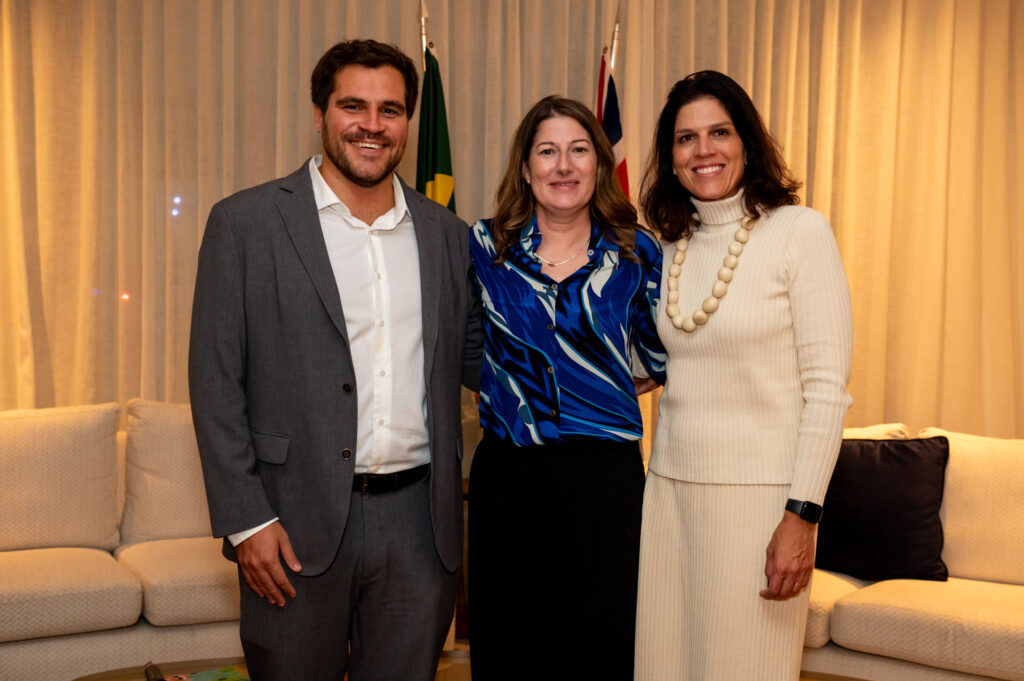
On March 19, a meeting took place between organizations promoting climate and nature solutions and representatives from the private sector and civil society focused on sustainable development. The event was held by the British Embassy in Brazil, in partnership with Instituto Arapyaú and The Earthshot Prize—the international environmental award created in 2020 by Prince William and now one of the most significant in the world.
During the event, various leaders and experts discussed complementary perspectives on business models linked to nature. The panel Protecting & Restoring Nature – Thriving Experiences Led by the Private Sector provided an opportunity for guests to deepen and share their knowledge. The debate, moderated by Marcelo Behar, COP30 Special Envoy for Bioeconomy, brought together Marcelo Barbará, founder of re.green; Germana Cruz, CEO of Standard Chartered; Joanna Martins, CEO and founder of Manioca; and Martha de Sá, CEO of Violet. Each highlighted paths, challenges, and opportunities for the financing and scalability of green initiatives.
The British Ambassador to Brazil, Stephanie Al-Qaq, emphasized the central role of the environmental agenda as a permanent axis of the bilateral relationship.
“Tonight was dedicated to focusing on innovative solutions that are both sustainable and scalable. There was a connection between government, civil society, and the private sector. These connections are very important for the emergence of innovative and sustainable solutions. What we need to do is expand them at scale,” she stated.
According to Al-Qaq, challenges include making the value of nature understandable and concrete for all of society. “We have supported Brazil on the nature agenda for a long time and seek to identify how we can contribute. An example is our involvement with the development of the Tropical Forest Forever Facility (TFFF), an initiative proposed by Brazil aimed at rewarding countries that preserve their tropical forests, in which we have participated since the beginning. Even today, there are UK institutions involved in advising the government and the fund on how to move forward from here,” said the ambassador. “The question is how to make everyone understand the value of nature and how to ensure that those who live in these areas, who live in these communities, are its protectors. And for the private sector as well, it is fundamental to have these voices at the table.”
For Renata Piazzon, CEO of Instituto Arapyaú, the partnership with the British Embassy and the Earthshot Prize helps position the country as a hub for concrete climate and nature solutions. However, she noted that projecting Brazil as an environmental powerhouse requires dealing with real implementation hurdles, such as the scalability of operations in the Amazon environment. Renata also highlighted the role philanthropy can play in this scenario: “The role of philanthropy is to systematize knowledge, qualify the debate, and generate evidence. It is also to facilitate a pre-competitive movement in this market because, in the forest restoration agenda, for example, several companies face similar challenges,” she stated.
Felipe Villela, Director of The Earthshot Prize in Brazil, stressed the urgency of articulating networks capable of financing and scaling existing solutions. According to him, bringing together leaders from different institutions to debate the private sector’s role in financing restoration projects is fundamental in this moment of transition. “This partnership with Arapyaú can enable this ecosystem so that we can scale solutions,” he said. “The green jobs market will multiply, reaching $50 million by 2030.” This is not the first time the Institute has worked with the award. Last year, the publication Brazilian Solutions for Global Challenges: Earthshot Prize Nominees was launched, featuring some of the Brazilian initiatives nominated throughout the ceremony’s five editions.
In this journey, the diversity of perspectives and experiences reveals a central point for this process: the climate agenda gains scale when translated into practice, with real learnings about implementation, territory, financing, and impact. “Spaces like this and some of the projects we are developing are incredibly important to try to build trust between communities, governments, and the private sector. I think we are going to start seeing things change,” said the ambassador.
Check out the photos from the event