

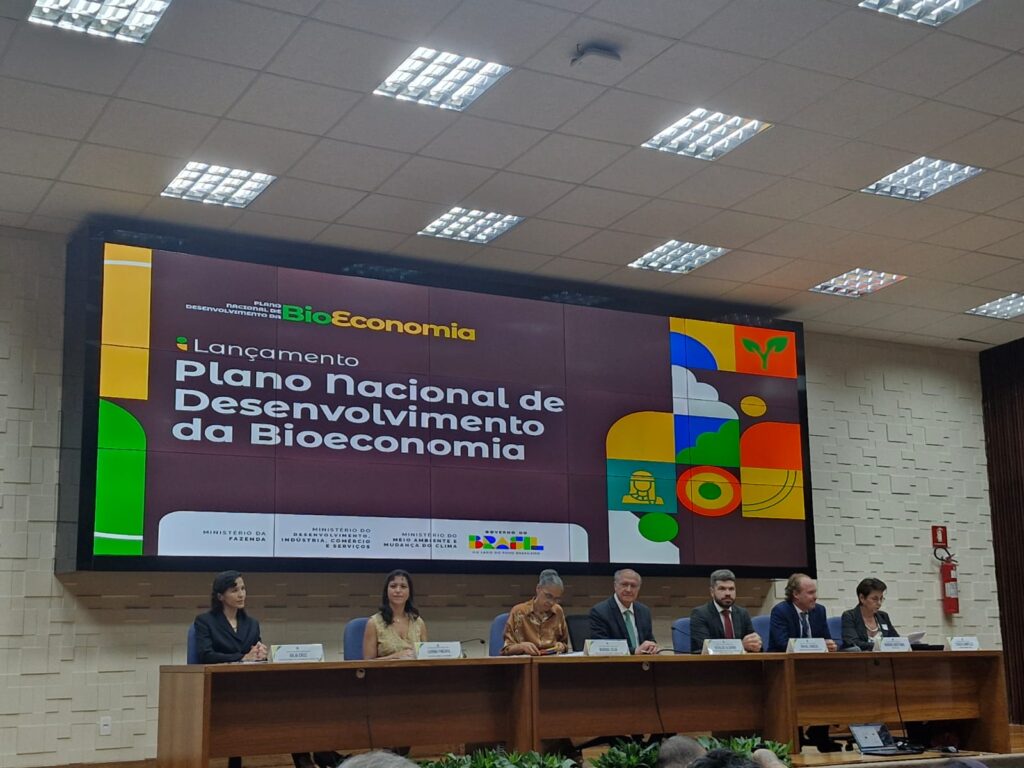
Foto: Victor Ferraz
On April 1, the Federal Government launched the National Bioeconomy Development Plan (PNDBio) during an event attended by the Vice President of the Republic, Geraldo Alckmin, and the Minister of Environment and Climate Change, Marina Silva. The plan establishes guidelines, goals, and actions to structure a new cycle of prosperity based on the sustainable use of the country’s natural assets through 2035. PNDBio defines 185 strategic actions that link environmental conservation, productive inclusion, and industrial innovation, with an ambitious proposal: to position Brazilian biodiversity as one of the main drivers of economic development, expanding opportunities ranging from community extraction to the pharmaceutical and cosmetic industries.
Organized into three major axes—socio-bioeconomy and environmental assets; competitive bio-industrialization; and sustainable biomass production—the plan combines actions aimed at the community base with industrial and innovation strategies. Goals include expanding payment for environmental services to 300,000 beneficiaries, supporting 6,000 socio-bioeconomy enterprises, restoring 2.3 million hectares of native vegetation, and consolidating 30 restoration territories.
In the industrial field, PNDBio foresees, for example, the incorporation of new herbal medicines into the Unified Health System (SUS) and increasing the share of these medicines in the national pharmaceutical industry’s revenue. In the biomass axis, the focus is on utilizing agricultural and forestry residues and strengthening bioenergy chains, such as biofuel production.
The construction of this public policy involved the direct participation of Instituto Arapyaú, which was part of the consortium led by the Brazilian Business Council for Sustainable Development (CEBDS), in partnership with The Nature Conservancy (TNC) Brazil and the Brazil Climate, Forests and Agriculture Coalition. The consortium provided technical support for the plan’s construction alongside the National Secretariat of Socio-bioeconomy. Drawing from its practical experience in territories such as southern Bahia and the Amazon, the Institute played a fundamental role in ensuring the plan went beyond conceptual guidelines by incorporating concrete and applicable solutions.
One of Arapyaú’s primary contributions to PNDBio was the conceptualization of the Socio-bioeconomy Development Hubs. These hubs are territorial networks involving different actors, designed to organize production chains, attract investment, and boost sustainable community businesses across different Brazilian biomes.
The development of this proposal included defining criteria for prioritizing territories and coordinating local listening processes, bringing together communities, entrepreneurs, and organizations. “As part of this work, we held workshops in southern Bahia, northern Minas Gerais, and the Araripe region, as well as meetings in Amazonian territories to map bioeconomy initiatives and evaluate their level of maturity,” says Victor Ferraz, bioeconomy coordinator at Arapyaú. This process allowed local experiences to be translated into structuring guidelines for the national policy, strengthening the connection between territory and strategy.
By recognizing the economic value of biodiversity and traditional practices, PNDBio also expands the reach of instruments such as the sharing of benefits from genetic heritage—a mechanism that ensures traditional communities receive a portion of the gains generated from the use of natural resources in industrial products.
Additionally, the plan anticipates the concession of 60 Conservation Units for ecotourism activities and the expansion of forest management areas, reinforcing the integration between conservation and income generation.