

Imagem: acervo pessoal
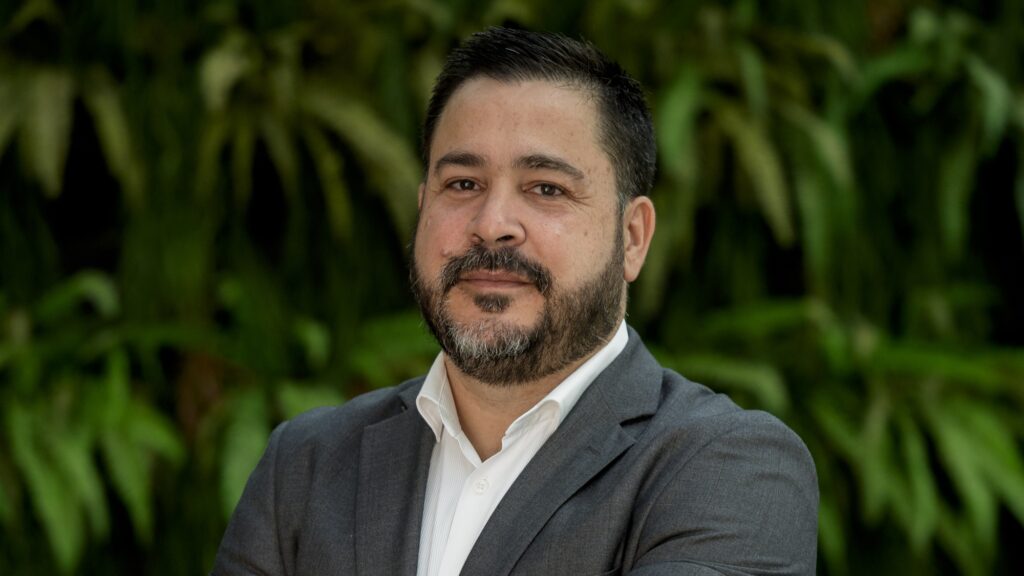
The trajectory of agronomist Fernando Sampaio follows, in a way, the transformations of Brazilian agribusiness in recent decades. The son of an agronomist himself, he grew up closely witnessing the expansion of agricultural frontiers and built a career that spans both the field and the backstage of the sector’s major decisions. From his experience in Europe during the mad cow crisis to his return to Brazil at a time of growing pressure on the beef chain, he gradually shifted from a technical role to a role in coordination and mediation.
This path led him to hold key positions in initiatives that seek precisely to balance production and sustainability—from the Brazilian Roundtable on Sustainable Livestock to ABIEC (Brazilian Association of Meat Exporting Industries), as well as the Brazil Climate, Forests and Agriculture Coalition and the PCI Strategy (Produce, Conserve, Include) in Mato Grosso. Now, as a fellow at Instituto Arapyaú, Sampaio turns to a challenge that has crossed his entire career: how to ensure that economic development and environmental conservation are no longer seen as opposites and, instead, truly walk together.
What possibilities for exchange do you see in this experience as an Arapyaú fellow? What are your expectations?
I see it as an opportunity to contribute to major global challenges, such as the climate crisis and food security—themes in which Brazil can play a central role. My expectation is to help unlock the transition to low-carbon agriculture and think of ways to reconcile agribusiness production with conservation. Especially in the Amazon, one of Arapyaú’s territories of operation, where livestock has a massive impact on land occupation. Precisely for this reason, it is important to understand it as part of the solution. I believe I can help in this interface between agribusiness and the forest.
What are currently the main bottlenecks for the advancement of low-carbon agriculture in Brazil?
The land tenure issue in the Amazon, for example, is a huge deterrent. Land and environmental regularization are central structural bottlenecks. There is also a data problem: Brazil produces a lot of information, but it is poorly integrated and underutilized. And, to me, another very critical point is the combination of investment with technical assistance. Sometimes the resources even exist, but they don’t reach where they are needed. And when they do arrive, the producer often lacks the necessary support to implement them.
How do you evaluate the cooperation between the public and private sectors and civil society in this agenda?
The first thing is to understand that no one solves this alone. Not the government, not the private sector, nor civil society. I think that is the great power of the networks that Arapyaú fosters: the connection between different actors to seek solutions together. Now, for this cooperation to actually happen, there are some obstacles. Political polarization is undoubtedly one of them. And I think we also need more neutral spaces that help build trust. A path I have always defended is to start with what is common to everyone. There are many things that everyone agrees on, such as fighting illegality, improving technical assistance, and advancing regularization. So, let’s start there.
Is there also a communication challenge in this environmental agenda?
There is, and it’s a big one. In many regions, especially in the Amazon, the environmental agenda is seen as an obstacle. As if it were a “you can’t” agenda: you can’t do this, you can’t do that. And this ends up being associated with the idea of a lack of development. We need to change this narrative and show that there is another possible model that generates income, jobs, and development, but from other bases, such as the bioeconomy, forest management, and carbon.
Instituto Arapyaú has a long history of fostering sustainable cocoa farming and has expanded its focus to other agri-food systems. How is it possible to increase the scale of this and other productive chains?
On small properties, there are experiences of livestock areas being restored with cocoa, generating practically double the income. This creates an opportunity for the producer to diversify their production with a product that will reach major traders, such as chocolate brands. It is a forest economy that could be fostered in many other areas of the Amazon occupied by extremely low-productivity livestock. At the end of the day, it is about the market. It is demand that will pull these chains. Brazil has clear opportunities because it imports cocoa. So, there is room to grow.
Are there other factors, besides the market, that are fundamental in fostering this forest economy?
It must be remembered that the cocoa producer in an agroforestry system will face competition from cocoa planted in full sun. The same thing happens with the rubber tapper in Acre who has to enter the forest to extract latex, while Malaysia has industrial rubber plantations. These are risks. We need to think of alternatives and, at the same time, invest in genetic heritage, research, and innovation. Our agriculture is strong because, in 1973, Embrapa was created to develop tropical agriculture. Brazil is still far below its potential in the forest economy because it lacks public and private research infrastructure to discover which species have potential and how to improve them.
You are pragmatic about the possibility of reconciling production and conservation.
Brazil does not need any more deforestation to produce more food. There is a massive underutilized area that can accommodate all future demand, whether from the international or domestic market. Now, the question is: how do we make that happen? To me, it involves organizing the base, and that’s where the land tenure issue comes in. You have public lands, community-held lands—indigenous territories, quilombola lands—and private lands. In all of them, there are areas with protected vegetation and others without. In the case of private areas, for example, there is a portion that needs to be maintained, another that needs to be restored, and another that can be used.
How can incentives be created so that the landowner wants to keep the forest standing?
That’s where a range of solutions comes in: payment for environmental services, carbon markets, bioeconomy, forest management. In other words, generating value for the standing forest. In public areas, the challenge is different: you have about 60 million hectares in the Amazon that have not yet been designated, and that is precisely where land grabbing happens. So, it is necessary to decide what these areas will be and provide that direction. In the end, we need planning and strategy. And, at the same time, policies that encourage agriculture to grow on already occupied and deforestrated areas, rather than advancing into the forest. If it is more advantageous to recover a degraded area than to open a new one, it will happen. But this doesn’t resolve itself; it needs to be a collective construction, with the government, private sector, and civil society sitting at the same table.
Your career is marked precisely by dialogue with actors of different, and often opposing, interests. What makes this type of coordination work?
I truly believe it’s about starting with what unites us. If you bring everyone together, there will be plenty of divergence, of course. But there are also many things that everyone agrees on. So, let’s first solve what is already a consensus. This helps build trust to move forward later on more difficult topics. And it is also important to identify leaders who are willing to engage in dialogue; that makes a big difference. Networks play a central role because they help bring these different perspectives together. Often, the government itself operates in “silos,” so networks help connect these points. And, more than that, they help build a common vision, which is what we need to advance at scale.